


Apptics Pay
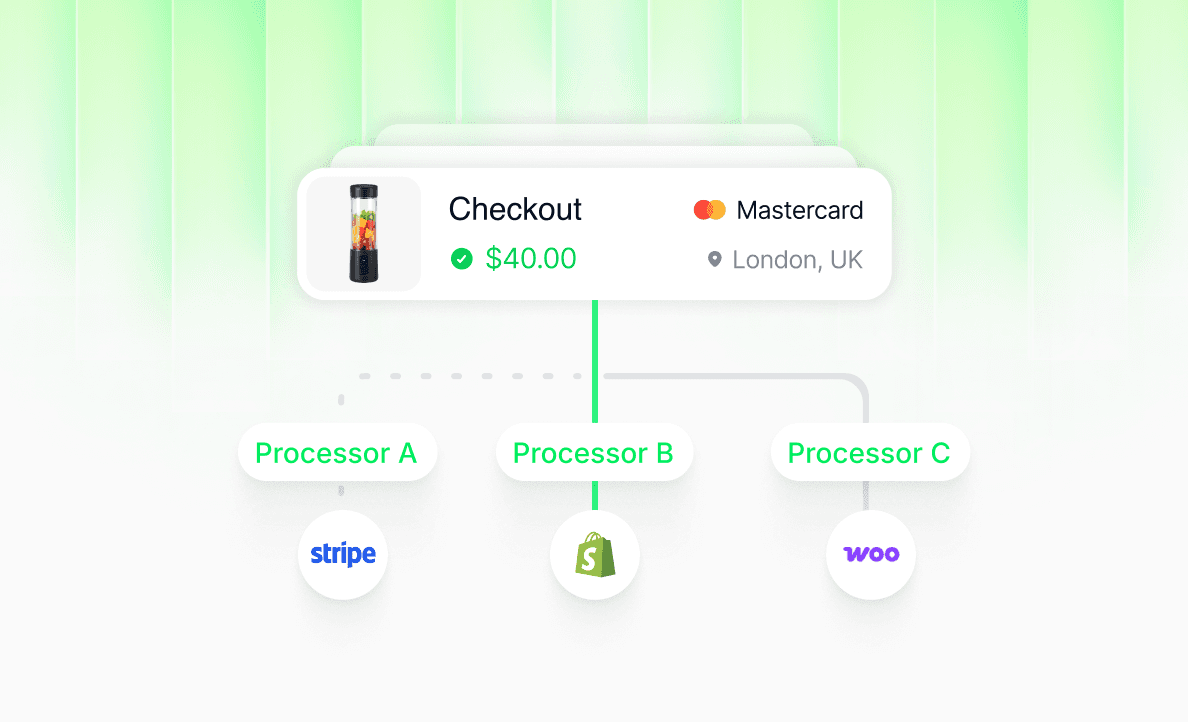
Payment orchestration sounds like enterprise jargon, but the idea is simple: don't let one processor decide whether you get paid. Here's what it is, how routing and cascading actually work, what it does for approval rates and shutdown risk, and when a scaling DTC brand needs it.
The one-processor problem
Most ecommerce brands start with one payment processor (Shopify Payments, Stripe or PayPal) and never think about it again. That works until it doesn't. A single processor means a single set of risk rules, a single approval algorithm and a single point of failure. If that account is reviewed, capped or closed, checkout stops. If its bank declines a good customer's card, that sale is gone, even if another bank would have approved it.
Payment orchestration is the fix big merchants have used for years, and it's now practical for mid-sized DTC brands too.
The short version: a payment orchestration layer connects your checkout to several payment processors, gateways and merchant accounts, then decides where each transaction goes based on rules and live performance. If one processor declines or goes down, it can retry on another (cascading). That lifts approval rates, removes single-processor risk and keeps your customers' card tokens portable. You can license an orchestration platform and run it yourself, or have it run for you. Apptics Pay and Apptics Checkout do the second.
Payment orchestration, defined
A payment orchestration platform is a layer between your checkout and the payment providers behind it. Through one integration it connects multiple payment service providers (PSPs), gateways, acquiring banks and payment methods, and routes each transaction according to configurable rules and real-time data. Industry definitions (NetSuite, and Gartner's criteria as summarized by Spreedly) share four core pieces: a single API or integration, dynamic routing and cascading without extra code, configurable routing rules, and a log of every transaction's state for reporting and audit.
In plain terms, it's air-traffic control for your payments.
How payment orchestration works
1. One integration, many processors
Your checkout talks to the orchestration layer once, and the layer talks to every processor you use. Adding or removing a processor doesn't mean rebuilding checkout.
2. Smart routing
Each transaction is sent where it's most likely to succeed or cost least. Common rules:
BIN-based routing: use the card's first digits (issuing bank, card type, country) to pick the processor that approves those cards best.
Load balancing: spread volume across merchant accounts so none hits its cap or attracts risk reviews.
Cost-based routing: send transactions to the cheapest route that still approves them.
Geography and currency: route international cards to processors set up for them.
3. Cascading (failover and retry)
If a transaction is declined for a reason another processor might accept, or a processor times out or goes down, the layer automatically retries on a backup. The customer doesn't re-enter anything. That turns some "declined" orders and failed subscription renewals into revenue.
4. Tokenization and a vault you control
Card details are tokenized and stored in a PCI-compliant vault that belongs to the orchestration layer, not to a single processor. This is the part subscription brands often underrate: if your customers' payment tokens live inside one processor, losing that processor can strand every active subscriber. With a portable vault, renewals keep running on another route.
5. Unified reporting
One view of approvals, declines (by reason code), costs and dispute ratios across every processor, so you see a problem with one route before it costs you.
What orchestration does for a DTC brand
Problem | Without orchestration | With orchestration |
|---|---|---|
Processor freezes or closes your account | Checkout stops until you're boarded elsewhere | Volume moves to other merchant accounts |
Good customers declined | Lost sale | Retry on a second route; route by BIN to the best approver |
Subscription renewals fail | Involuntary churn | Smart retries and cascading recover renewals |
Volume caps | Growth throttled by one account's limit | Volume distributed across several MIDs |
Switching processors | Painful migration; subscribers may need to re-enter cards | Add or drop processors behind the same checkout and vault |
Do you need it? A quick test
You probably do if two or more of these are true:
You process more than one merchant account's comfortable volume, or have hit a cap.
You're in a category processors label high-risk (supplements, CBD, subscriptions, etc.).
Subscriptions or continuity drive a big share of revenue.
You sell internationally.
You've had a payout hold, reserve or closure before.
Your approval rate is below where you think it should be, and no one can say why.
If none apply, one good processor is probably fine for now.
Build, buy or done-for-you
Option | What it is | Good fit for |
|---|---|---|
Enterprise orchestration platform (e.g. Primer, Gr4vy, Spreedly, IXOPAY) | Software you license and integrate; your team configures routing and manages processor relationships | Large merchants with payments engineers and existing processor contracts |
Checkout/CRM platforms with built-in routing | Routing across many gateways inside a checkout or CRM you operate | Teams that want to run their own funnels and routing |
Done-for-you orchestration (Apptics) | Merchant accounts, routing, checkout and chargeback protection set up and run by an operator team | Shopify and DTC brands that want the outcome without building a payments team |
Software alone doesn't create merchant accounts. Routing across processors only helps if you have healthy accounts to route to, so getting approved by more than one bank is often the real bottleneck for high-risk brands.
A note for Shopify stores
On Shopify, orchestration usually means processing outside Shopify Payments, so plan for Shopify's third-party transaction fee (2% on Basic down to 0.2% on Plus), and for how your checkout handles multiple routes. Many brands pair orchestration with a custom checkout layer for exactly that reason. We cover the trade-offs in high-risk payment processors for Shopify and the checkout side in Shopify checkout customization.
How Apptics does payment orchestration
Apptics builds orchestration into a done-for-you stack instead of selling it as a dashboard:
Payments orchestration with BIN-based routing, included in Apptics plans, plus MID management and routing run by our team (Apptics Checkout, pricing).
PCI tokenization and vault, with subscriber MRR that stays portable across any gateway, so a processor change doesn't break renewals.
Smart Salvage AI and AI Smart Retry & Salvage (Enterprise) to recover failed payments.
Merchant accounts to route to: Apptics Pay offers multi-bank processing across 35+ banks with human underwriting, pre-approval before migration and no processor lock-in.
Chargeback protection built in: Apptics Shield keeps dispute ratios low across every account, with real-time VAMP reporting on the Pay side.
What it looks like in practice: first-attempt approval rose from 93.6 percent to 95.2 percent with orchestration for one brand, and one international merchant went from $241K to $1.4M in monthly processing in 90 days, when payments had been the blocker. As Rayan M., an 8-Fig Ecom Entrepreneur, put it: "Apptics helped us process $1.5M in sales and setup back up processors when we were having troubles processing payments."
Critical questions answered
What's the difference between a payment gateway and payment orchestration?
A gateway connects your checkout to one processor. Orchestration sits above gateways and connects to many, deciding where each transaction goes and retrying elsewhere if it fails.
Does payment orchestration increase approval rates?
It can. Routing by card BIN to the processor that approves those cards best, and cascading declines to a backup route, recovers transactions a single processor would lose. Results depend on your mix of cards, processors and decline reasons.
Is payment orchestration only for enterprises?
Not anymore. Enterprise platforms still assume a payments team, but done-for-you providers like Apptics bring the same model to mid-sized DTC brands.
What is cascading in payments?
Cascading automatically retries a declined or failed transaction on another processor or merchant account, without the customer re-entering their details.
Can I use payment orchestration with Shopify?
Yes, through third-party processing and a checkout that supports multiple routes. Budget for Shopify's third-party transaction fee.
The bottom line
Payment orchestration turns payments from a single point of failure into infrastructure: several merchant accounts, smart routing, automatic retries and a vault you control. For a brand that depends on subscriptions, sells in a high-risk category or is scaling fast, that's the difference between a processor problem being an incident and being an outage. The real question isn't whether you need it. It's whether you want to build and run it yourself or have it run for you.
Key takeaway: Orchestration = one integration, many processors, smart routing, cascading retries and portable tokens. It raises approvals and removes the risk of one processor switching your revenue off.
See what orchestration would do for your approval rate
Book a demo and we'll look at your current processors, decline reasons and dispute ratio, and show you where routing, redundancy and recovery would add revenue.
Check out more of our stories.

The Best Shopify Subscription Apps (2026)
Compare the best Shopify subscription apps (Recharge, Loop, Bold, Skio, Stay Ai, Smartrr, Appstle, Ordergroove): what each is best for, real pricing models, and the retention work you still have to run yourself.
Payments

Shopify Checkout Customization: The Complete 2026 Guide
What you can customize in the Shopify checkout on each plan, the changes that lift conversion and AOV, and how to get deep customization without Shopify Plus.
Payments

Apptics Pay vs Maverick Payments: Which Fits a Scaling Ecom Brand?
Maverick Payments is a single full-service processor with a proprietary gateway. Apptics Pay is done-for-you multi-processor orchestration with MID redundancy. Compare the models, high-risk support, pricing, and fit.
Payments

Apptics Pay vs Shopify Payments: Which Fits Your Store?
Shopify Payments is the easy built-in default, but it is a single Stripe-backed processor that can be held or suspended. Compare it with Apptics Pay's done-for-you multi-processor orchestration for high-risk, international, and subscription brands.
Payments