


Apptics Pay
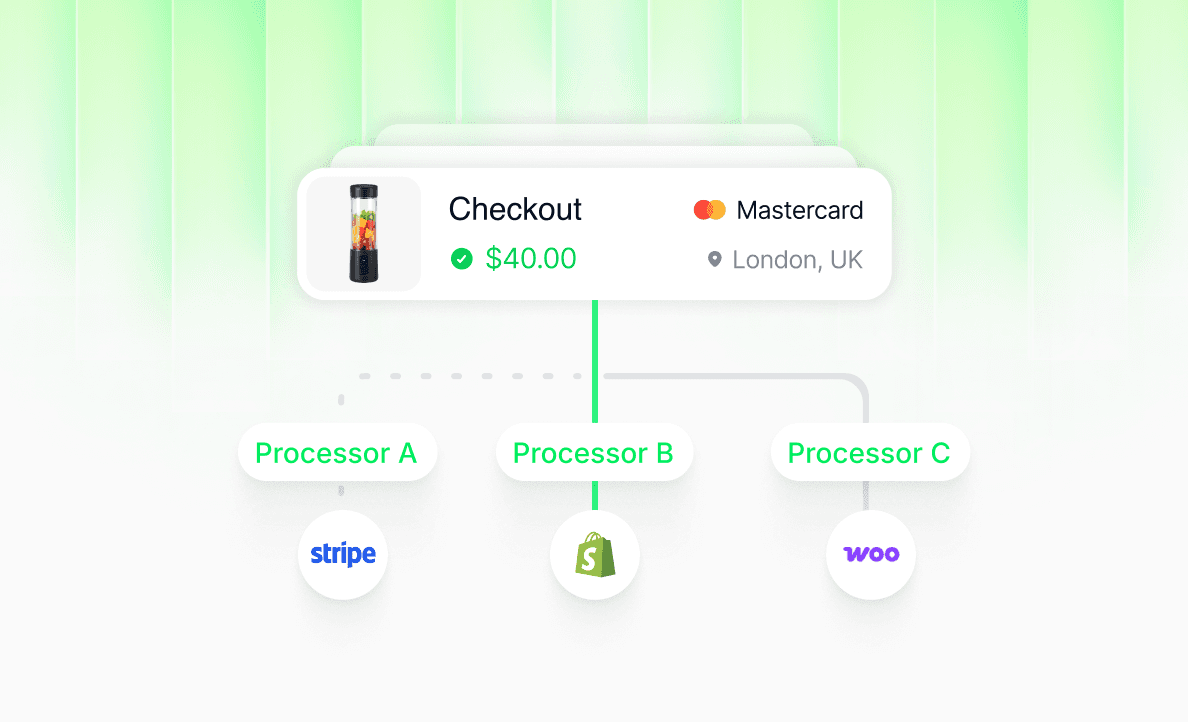
Shopify Payments is the easy default until your category, chargeback ratio or growth curve stops fitting it. This guide covers why Shopify stores get flagged as high-risk, how third-party processing works on Shopify (fees included), what underwriting asks for, and how to set things up so one decision can't switch your revenue off.
When Shopify Payments stops being an option
Most Shopify merchants never think about payment processing because Shopify Payments just works. It's built in, there's no separate application, and you avoid Shopify's third-party transaction fees. The catch is that it's a single, standardized processor with rules that are the same for everyone. If your business falls outside those rules, you find out the hard way: an application that won't activate, payouts placed on hold, or a closure notice the week a launch takes off.
Some categories are out from the start. Shopify's help center says Shopify Payments doesn't support hemp, CBD or THC products, and that supplements and nutraceuticals making health claims not verified or approved by the relevant regulator are prohibited. Beyond category, the restricted-business rules are country-specific and maintained by the underlying processor. Other businesses start fine and get flagged later because of chargebacks, refund rates or sudden volume spikes. (If you're in that situation now, start with what to do when Shopify Payments puts you under review.)
The short version: you don't have to leave Shopify to process as a high-risk business. Shopify supports 100+ third-party payment providers. A high-risk processor underwrites your business before boarding you, so the risk is accepted up front instead of discovered later. Budget for Shopify's third-party transaction fee (2% on Basic down to 0.2% on Plus) on top of processing. For brands whose revenue depends on payments never stopping, the stronger setup is more than one merchant account with routing between them. That's what Apptics Pay builds and runs for you.
What makes a Shopify store "high-risk"?
"High-risk" isn't a judgment of your business. It's how a processor prices the chance of chargebacks, fraud, regulatory trouble or refunds landing on it. The common triggers:
Category: CBD and hemp, supplements and nutraceuticals, adult, firearms and accessories, travel, ticket resale, MLM, high-ticket furniture, dropshipping.
Business model: subscriptions and continuity offers, free-trial funnels, pre-orders and long fulfillment windows.
History: a past processor closure, a MATCH-list entry, or a chargeback ratio near network thresholds (Visa's merchant "Excessive" line dropped to 1.5% in April 2026).
Volume profile: fast growth, big average tickets, or a large share of international cards.
If any of these describe you, you'll get further by applying to a processor built for high-risk than by reapplying to another low-risk aggregator.
How third-party processing works on Shopify
Shopify lets you accept cards through a provider other than Shopify Payments, either as your only card processor or alongside Shopify Payments for things like Shop Pay. There are two types:
Direct providers: the customer pays without leaving your Shopify checkout.
External providers: the customer completes payment on a page hosted outside your store. That adds a step, which usually costs conversion.
Shopify lists Authorize.net among its supported providers. Many high-risk merchant accounts connect to Shopify through gateways like it.
The fees to budget for
Fee | What it is | Typical amount |
|---|---|---|
Processor rate | What your high-risk processor charges per transaction | Quoted after underwriting; higher than low-risk rates |
Shopify third-party transaction fee | Charged by Shopify on orders processed through a non-Shopify-Payments gateway | 2% (Basic), 1% (Grow), 0.6% (Advanced), 0.2% (Plus) |
Shopify Payments premium (if run alongside) | When Shopify Payments runs next to a third-party provider, its transactions (e.g. Shop Pay) carry a premium | Standard rate +1.25% |
Reserve | A share of funds held to cover future chargebacks | Set by the processor; ask before you sign |
At scale, the third-party transaction fee is a big reason high-volume high-risk brands look closely at their Shopify plan. Model it before you switch.
What underwriting will ask for
A high-risk processor's upfront review is the point: it accepts your risk before you go live, instead of reviewing you after a spike. Expect requests like:
Business registration, ownership details and a business bank account
Recent processing statements or financials
Your website, with visible refund, shipping, privacy and terms pages
Product details and category-specific documentation (e.g. lab results or COAs for CBD, label claims for supplements)
Chargeback and refund history, and an explanation of any past closure
Clean policies and honest disclosure speed approvals up. Hiding a past shutdown slows them down, because it usually surfaces anyway.
One merchant account vs several
Single high-risk merchant account | Multiple MIDs with routing (orchestrated) | |
|---|---|---|
What you get | One dedicated, underwritten account | Several accounts, with volume distributed and declines rerouted |
If the account is flagged or capped | Processing stops until it's resolved | Volume shifts to the other accounts |
Approval rates | Whatever one bank approves | Declines can retry on another processor; routing can follow card BIN |
Effort | Simpler to set up and manage | More complex. Best run by a team that does it daily |
A dedicated high-risk account is a real step up from a low-risk aggregator. It's still one point of failure, though. The more revenue runs through payments, the more redundancy is worth.
How Apptics Pay works for Shopify stores
Apptics Pay is done-for-you high-risk payment processing built for ecommerce. You don't have to leave Shopify, and you don't run the processing yourself.
Fill out one merchant application. Apptics reviews your business up front and matches you with the right merchant account, with human underwriting and pre-approval before you migrate.
Get approved and connect. Most qualified merchants are approved within 48–72 hours. Your Shopify store (or WooCommerce, or Apptics Checkout) connects through NMI or Authorize.net.
Start processing. Go live on accounts built for long-term stability, with Apple Pay and Google Pay support.
What sets it apart:
Multi-bank processing across 35+ banks, with no processor lock-in. You own the relationship and can add or switch processors anytime.
Real-time VAMP reporting, so you see ratio trouble coming before your processor does.
Meet or beat current rates.
24/7 human support from specialists who understand high-risk ecommerce (Telegram, 24/7).
High-risk verticals served: adult, furniture, firearms, CBD, travel, high-volume, ticket brokers, MLM, dropshipping and general ecommerce.
Built into the full stack: pair it with Apptics Shield to keep dispute ratios low, and with Apptics Checkout for payments orchestration, BIN-based routing and a checkout that keeps your subscriber tokens portable across gateways.
One merchant on Apptics: "Apptics helped us process $1.5M in sales and setup back up processors when we were having troubles processing payments." (Rayan M., 8-Fig Ecom Entrepreneur)
Checklist: before you switch processors
Get approved before you turn anything off. Never leave a working setup until the new account is live and tested.
Plan for held funds. A processor you're leaving may hold a reserve for months to cover late chargebacks.
Confirm your category and countries in writing. You're switching because something didn't fit, so get the new fit confirmed.
Model the full cost: processor rate + Shopify third-party fee + any reserve.
Fix chargebacks at the same time. A new account inherits your dispute behavior. Alerts and prevention keep it healthy.
Think about subscriptions. Make sure your subscriber payment tokens can move with you, or a processor change will break renewals.
Critical questions answered
Can high-risk businesses use Shopify?
Yes. Shopify's platform rules and Shopify Payments' rules are different things. Many businesses Shopify Payments won't support can still sell on Shopify through a compatible third-party provider, as long as the products are allowed on Shopify itself. Check Shopify's Acceptable Use Policy for your category.
What's the best high-risk payment processor for Shopify?
It depends on your category and how much you want to run yourself. A dedicated high-risk merchant account suits many stores. Scaling brands that can't afford downtime are better served by multiple accounts with routing. We compare options in the best Stripe alternatives for high-risk merchants.
Will I pay extra fees using a third-party processor on Shopify?
Yes. Shopify charges a third-party transaction fee of 2%, 1%, 0.6% or 0.2% depending on your plan, on top of your processor's rate.
How fast can I get a high-risk merchant account?
It varies by provider and how complete your file is. Apptics Pay gets most qualified merchants approved within 48–72 hours.
I was shut down by Shopify Payments or Stripe. Can I still get approved?
Often, yes. High-risk underwriting expects history. Be upfront about the closure and what caused it. See Stripe account frozen? What to do right now.
The bottom line
Being high-risk on Shopify doesn't mean leaving Shopify. It means choosing processing built to accept your business up front: a dedicated high-risk merchant account at minimum, and ideally several, routed so no single decision can stop your sales. Budget for Shopify's third-party fee, get approved before you switch, and fix your dispute ratio at the same time.
Key takeaway: Shopify Payments is one processor with one set of rules. High-risk Shopify brands stay live by getting underwritten up front and never depending on a single merchant account.
Get approved and keep processing
Whether you've been shut down, hit with reserves or outgrown Shopify Payments, Apptics helps you secure reliable processing and keep revenue flowing. Book a call and we'll review your situation and tell you straight what's possible.
Check out more of our stories.

The Best Shopify Subscription Apps (2026)
Compare the best Shopify subscription apps (Recharge, Loop, Bold, Skio, Stay Ai, Smartrr, Appstle, Ordergroove): what each is best for, real pricing models, and the retention work you still have to run yourself.
Payments

Shopify Checkout Customization: The Complete 2026 Guide
What you can customize in the Shopify checkout on each plan, the changes that lift conversion and AOV, and how to get deep customization without Shopify Plus.
Payments

Apptics Pay vs Maverick Payments: Which Fits a Scaling Ecom Brand?
Maverick Payments is a single full-service processor with a proprietary gateway. Apptics Pay is done-for-you multi-processor orchestration with MID redundancy. Compare the models, high-risk support, pricing, and fit.
Payments

Apptics Pay vs Shopify Payments: Which Fits Your Store?
Shopify Payments is the easy built-in default, but it is a single Stripe-backed processor that can be held or suspended. Compare it with Apptics Pay's done-for-you multi-processor orchestration for high-risk, international, and subscription brands.
Payments