


Apptics Shield

Short answer: friendly fraud is when a real customer disputes a purchase they actually made or authorized. Here is why it happens, why it costs more than the refund, and how to stop friendly fraud chargebacks before they reach your ratio.
The chargeback that comes from your own customer
Most merchants picture fraud as a stranger with a stolen card. Friendly fraud is different. The person disputing the charge is the real cardholder, or someone in their household, and the order was real. They simply go to their bank instead of to you. Sometimes it is a mistake. Sometimes it is deliberate. Either way, it arrives as a chargeback, and it is treated like one.
That is what makes it so expensive. A friendly fraud chargeback takes the sale, the product you already shipped and a dispute fee, and it counts against the dispute ratio your processor watches. For a subscription or high-volume store, a steady trickle of these is enough to push a merchant account toward Visa's monitoring thresholds.
This explainer covers what friendly fraud is, the most common causes, why fighting it after the fact is not enough, and how a prevention-first setup like Apptics Shield stops it before it reaches your ratio.
The short version: Friendly fraud is a chargeback filed by a legitimate customer on a purchase they made or authorized: a forgotten subscription, an unrecognized descriptor, a family member's order, or buyer's remorse. Fighting these disputes can win money back, but each one still counts against your ratio. The fix is to catch them before they are filed, with clear billing, easy refunds and pre-dispute alerts, which is exactly what Apptics Shield automates.
What is friendly fraud?
Friendly fraud, sometimes called first-party fraud or chargeback fraud, is a dispute where the cardholder claims a transaction was unauthorized or a problem, even though they made or allowed the purchase. The bank sees a cardholder complaint, files a chargeback, and the burden shifts to the merchant to prove the sale was valid.
Accidental friendly fraud: The customer genuinely does not recognize the charge or forgot about it. This is the larger and more fixable group.
Deliberate friendly fraud: The customer knows they bought it and disputes it anyway to keep the product and the money. This is smaller, harder to prevent, and where evidence matters most.
Both look the same in your dispute dashboard, and both count the same against your ratio.
Why friendly fraud happens
Most friendly fraud traces back to a handful of causes, and almost all of them are about confusion rather than malice.

An unrecognized billing descriptor. The name on the statement does not match the store name the customer remembers, so the charge looks like fraud.
A forgotten subscription or free trial that converted to a paid rebill.
A purchase made by a family member, often a child, on a saved card.
A slow or hard refund process, so the bank feels like the faster route.
Delivery problems or a product that did not match expectations, where the customer never contacted support.
Buyer's remorse after a larger or impulse purchase.
Notice how many of these are under your control. Clear descriptors, clear rebill reminders and an easy refund path remove most of the reasons a real customer goes to the bank.
Why it costs more than the refund
A chargeback is always more expensive than a refund. With a refund, you lose the sale. With a chargeback, you lose the sale, often the product, a dispute fee, and the time to respond, and the dispute counts on your record.
The ratio is the real cost: Visa's monitoring program, VAMP, counts disputes and fraud reports against your settled card-not-present transactions, and since April 2026 most merchants are flagged as Excessive at 1.5 percent once they have at least 1,500 counts in a month. A dispute counts when it is filed, whether you later win it or not.
Processors react first: Acquirers are measured on their whole portfolio at much lower levels, so many add reserves or holds well before you reach Visa's merchant line. One chargeback spike can freeze payouts or shut down a merchant account.
Fighting friendly fraud after the fact
When a friendly fraud dispute lands, you can represent it: send evidence to the issuer that the cardholder made the purchase. That is worth doing, and Visa's Compelling Evidence 3.0 rules, in place since April 2023, made it stronger for one common case.
Compelling Evidence 3.0: For card-absent fraud disputes (Visa reason code 10.4), you can point to two earlier, undisputed transactions on the same card at your store, between 120 and 365 days old, where at least two data points match the disputed order (such as user ID, shipping address, IP address or device ID, with at least one being IP or device). Qualifying cases shift liability back to the issuer, and Visa excludes qualifying fraud from the VAMP ratio.
Keep order confirmations, delivery tracking and customer communications for every order.
Capture and store IP address, device ID and account login data, so repeat customers qualify for CE 3.0.
Show subscription terms and consent at checkout, and keep the record.
The limit of this approach is the same as any recovery strategy. Winning returns the money, but the dispute was still filed and still counted.
How to prevent friendly fraud chargebacks
Prevention means removing the reasons customers dispute and catching the disputes that start anyway, before they become chargebacks.
Tactic | What it stops | Effort |
|---|---|---|
Recognizable billing descriptor and support contact | "I don't recognize this charge" disputes | Low |
Rebill reminders and easy cancellation | Forgotten subscriptions and trials | Low to medium |
Fast, visible refund and support path | Customers going to the bank first | Low |
Order confirmations and delivery updates | "Never received it" disputes | Low |
Pre-dispute alerts (RDR, Ethoca) with auto-refunds | Disputes that have already started at the bank | Medium, or done for you |
Evidence capture for CE 3.0 | Repeat-customer fraud claims you can win | Medium |
General prevention tactics. Alert networks, eligibility and rules vary by card network and processor.
The most powerful row is pre-dispute alerts. When a cardholder starts a dispute, alert networks such as Visa's RDR and Mastercard's Ethoca can surface it to you before a chargeback is formally filed. Refund inside that window and no chargeback is recorded. Disputes resolved through Visa's pre-dispute tools are excluded from the VAMP ratio.
Why merchants switch to Apptics Shield to stop friendly fraud
Friendly fraud is the most preventable chargeback there is, because the customer is real and usually just wants their money back. Apptics Shield is built to give it to them before they go to the bank. Shield watches for disputes and triggers refunds automatically, 100% hands-off, so a confused customer gets a refund and your record never gets a chargeback. Slash your chargeback rate by up to 97%.
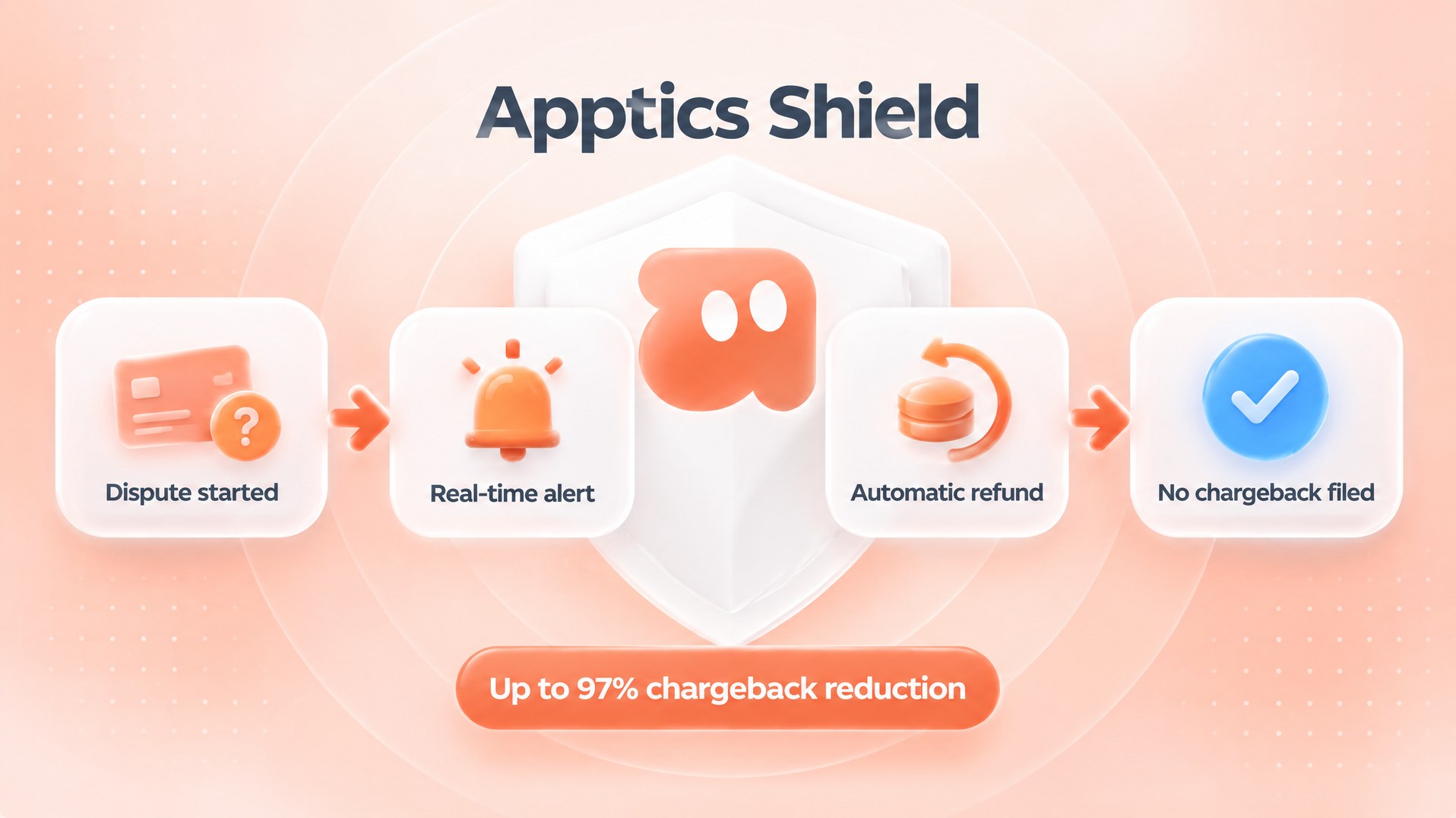
Caught at the bank, resolved before filing: Real-time Ethoca and Verifi alerts flag a dispute the moment a cardholder starts it. Shield refunds inside the window, so the dispute is resolved pre-filing and kept out of your VAMP ratio. That is the "forgotten subscription" and "I don't recognize this charge" dispute handled without a fight.
Rules that protect margin, not just the ratio: Auto-refund rules for low-AOV orders, agent review for high-AOV orders, and automatic credits for invalid alerts. Shield also works with your processor and CRM data, with subscription data integration included, which matters because forgotten rebills are the classic friendly fraud trigger.
The lowest alert prices, no lock-in: As an official Disputifier and Chargeblast partner, Apptics gives you real-time alerts at industry-lowest rates, 30-50% less than buying alerts directly. RDR alerts are $13-19 and Ethoca alerts $17-27. No monthly fee. No lock-in. Cancel any time. You only pay for valid alerts.
Live in 5 minutes: One-click integration with Stripe, Shopify Payments, PayPal, high-risk merchant accounts and more. No code, no developers, with AI monitoring 24/7 and 24/7 human support.
Proven on real ratios: One merchant went from a 2.1 percent dispute ratio, flagged as Excessive under VAMP, to 0.31 percent in 90 days, with monthly disputes falling from 420 to 62 and average alert cost dropping from $28 to $15. Across merchants, Shield has protected $50M+ in revenue.
Recovery is still there as a backstop for anything that slips through, through the same Disputifier and Chargeblast partnerships, so you are not choosing between prevention and recovery.
Apptics Shield vs typical chargeback alternatives:
Apptics Shield | Typical alternatives | |
|---|---|---|
Alert cost | $13 - $27 per alert | $18 - $29 per alert |
Setup time | 5 minutes | Hours or days |
Monthly fees | $0 | Yes |
Subscription data integration | Included | Rarely included |
24/7 human support | Included | Limited or none |
Alert delivery | Real-time | Delayed alerts |
Hands-off automation | 100% hands-off | Manual work required |
Comparison as published on apptics.ai/shield.
When Apptics Shield is the better fit: you run subscriptions or rebills, your disputes are mostly "unrecognized charge," "cancelled" or "not received" claims from real customers, your ratio is creeping toward Visa's 1.5 percent line, or nobody on your team has time to work disputes. A recovery-only tool can win some of those disputes back, but every one still counts; Shield stops them from being filed. See Apptics Shield, or read how the two main alert networks differ in RDR vs Ethoca alerts.
Common mistakes with friendly fraud
Treating every dispute as a fight: For a low-value order, refunding through an alert is usually cheaper than winning a representment, and it keeps the ratio clean.
Hiding the cancel button: Making subscriptions hard to cancel does not save revenue. It turns cancellations into chargebacks.
Using a descriptor nobody recognizes: If your statement name does not match your store, you are inviting "unrecognized charge" disputes.
Not capturing evidence: Without IP, device and account data, repeat-customer fraud claims are much harder to win.
Critical questions answered
What is friendly fraud? A chargeback filed by a legitimate customer on a purchase they made or authorized, whether by mistake (they forgot or did not recognize it) or on purpose.
Is friendly fraud illegal? Deliberately disputing a purchase you made and received can amount to fraud, but most friendly fraud is accidental. For merchants, the practical question is prevention, not prosecution.
Can you win friendly fraud chargebacks? Often, with good evidence, and Visa's Compelling Evidence 3.0 helps for repeat customers. But a won dispute still counts against your ratio, so prevention matters more.
How do chargeback alerts stop friendly fraud? They flag a dispute before it becomes a chargeback, so you can refund in time. No chargeback is recorded, and disputes resolved through Visa's pre-dispute tools are excluded from the VAMP ratio.
The bottom line
Friendly fraud is the chargeback that comes from your own customer, and most of it is confusion: an unrecognized descriptor, a forgotten rebill, a family member's order or a refund that felt too hard. It costs more than a refund because it counts against the ratio that decides whether you keep processing. Fight the disputes you can win with good evidence, but put most of the effort into prevention: clear billing, easy refunds and pre-dispute alerts that let you resolve a dispute before it is filed. Apptics Shield is the better way to do that: real-time alerts and automatic refunds that resolve friendly fraud before it is filed, up to 97% chargeback reduction, $13 to $27 per valid alert with no monthly fee, live in 5 minutes. Book a demo with Apptics and stop paying for chargebacks your customers never meant to file.
Frequently asked questions
What is an example of friendly fraud?
A customer signs up for a subscription, forgets about it, sees the rebill on their statement, does not recognize the descriptor, and asks their bank to reverse it instead of contacting the store.
What is the difference between friendly fraud and true fraud?
In true fraud, a criminal uses a stolen card without the cardholder's knowledge. In friendly fraud, the real cardholder (or someone they allowed) made the purchase and then disputes it.
How do I prevent friendly fraud on Shopify?
Use a recognizable billing descriptor, send order and rebill emails, make refunds and cancellations easy, capture IP and device data, and add pre-dispute alerts such as RDR and Ethoca with automatic refunds.
Does friendly fraud count toward my chargeback ratio?
Yes. A friendly fraud chargeback counts as a dispute when it is filed, even if you later win it. Only disputes stopped before filing stay out of the count.
How does Apptics Shield reduce friendly fraud chargebacks?
Shield uses real-time Ethoca and Verifi alerts and automatic refunds to resolve disputes before they become chargebacks, with up to 97 percent chargeback reduction reported at full coverage.
Key takeaway: Friendly fraud is a dispute from a real customer on a real purchase, and most of it is preventable confusion. Winning the chargeback returns the money but still counts against your ratio. Apptics Shield stops it before it is filed with real-time alerts and automatic refunds, taking one merchant from 420 monthly disputes to 62 in 90 days. Book a demo to see what Shield would catch on your store.
Check out more of our stories.

The Best Shopify Subscription Apps (2026)
Compare the best Shopify subscription apps (Recharge, Loop, Bold, Skio, Stay Ai, Smartrr, Appstle, Ordergroove): what each is best for, real pricing models, and the retention work you still have to run yourself.
Payments

Shopify Checkout Customization: The Complete 2026 Guide
What you can customize in the Shopify checkout on each plan, the changes that lift conversion and AOV, and how to get deep customization without Shopify Plus.
Payments

Apptics Pay vs Maverick Payments: Which Fits a Scaling Ecom Brand?
Maverick Payments is a single full-service processor with a proprietary gateway. Apptics Pay is done-for-you multi-processor orchestration with MID redundancy. Compare the models, high-risk support, pricing, and fit.
Payments

Apptics Pay vs Shopify Payments: Which Fits Your Store?
Shopify Payments is the easy built-in default, but it is a single Stripe-backed processor that can be held or suspended. Compare it with Apptics Pay's done-for-you multi-processor orchestration for high-risk, international, and subscription brands.
Payments