


General Guides

A fair, current comparison of Skio and Recharge for Shopify subscriptions: what each is best at, how their published pricing works out at real volumes, what the Recharge acquisition of Skio changes, and the one thing neither does for you.
Skio vs Recharge is now a choice inside one company
For years, Skio vs Recharge was the classic Shopify subscriptions match-up: the established incumbent against the fast-moving challenger. In April 2026 that changed. Recharge acquired Skio, and the two now sit under one roof. Both companies say the products keep running independently for now, with separate teams, and Skio's own announcement talks about preserving both platforms while they combine the best of each over roughly the next 12 months.
That makes the comparison more useful, not less. You are still choosing between two different products with different pricing, different portals and different philosophies. You are just choosing which product line to bet on inside the same company.
Below is an honest breakdown of what each platform is best for, how their published pricing compares at three revenue levels, what the acquisition means in practice, and the structural point most comparisons skip: both are self-serve apps, and the retention work that decides whether subscribers stay is still yours to run. That gap is why a growing number of Shopify DTC brands skip the app decision entirely and move to Apptics Checkout, where the subscription engine is built and run for you.
The short version: Recharge is the established default, with the deepest ecosystem and a lower base fee (Starter $99/mo + 1.49% + 19¢ per transaction). Skio suits fast-growing Shopify brands that want a polished portal and hands-on onboarding, at a higher base (Scale from $499/mo billed annually + 1% + 20¢ on subscription orders). At higher volume, Skio's lower percentage can make it cheaper. Both are now owned by Recharge, and both are tools you still operate yourself. If you would rather have subscriptions, retention and rebill recovery run for you, Apptics Checkout is the better choice.
Skio vs Recharge at a glance
Start here, then read the detail below. Figures are as each company publishes them on its pricing page or Shopify App Store listing as of October 2026.
Recharge | Skio | |
|---|---|---|
Best for | The safe, established default at scale | Fast-moving DTC and Shopify Plus brands |
Entry price | Starter $99/mo + 1.49% + 19¢ per transaction | Scale $599/mo monthly, or $499/mo billed annually |
Higher tier | Plus $499/mo + 1.34% + 19¢; Custom volume-based | Enterprise, custom volume pricing |
Transaction fee basis | All transactions processed by Recharge | 1% + 20¢ on orders involving a subscription |
Small-store option | $25/mo plan, no transaction fees for the first 50 subscribers | None published |
Free trial | 60-day trial on Starter | No self-serve trial published |
On the Shopify App Store since | October 2014 | April 2021 |
App Store rating | 4.8 from 3,138 reviews | 5.0 from 243 reviews |
Ownership | Recharge | A Recharge company since April 2026 |
Pricing and ratings change. Confirm current terms on each provider's pricing page or Shopify App Store listing before you commit. Both companies' fees are charged in addition to your payment processor's fees.
What Recharge is best at
Recharge is the most established subscription platform on Shopify, listed on the App Store since 2014 with more than 3,000 reviews. It is the low-regret pick: a mature customer portal, cancellation-prevention flows, failed-payment recovery (Recharge markets recovering up to 88 percent of failed payments), win-back tools, and a large agency ecosystem that already knows it.
Its pricing is published and tiered. Starter is $99/mo plus 1.49 percent plus 19¢ per transaction, with a 60-day free trial. Plus is $499/mo plus 1.34 percent plus 19¢, with hands-on implementation, migration support, bundles, Concierge SMS and loyalty tools. Custom is volume-based for high-volume brands. Recharge's App Store listing also shows a $25/mo plan with no transaction fees for the first 50 subscribers. Plus and Custom run on 12-month terms.
Where Recharge fits best: brands that want the incumbent, deep integrations and predictable support, and that are early enough that a lower base fee matters more than the percentage.
What Skio is best at
Skio came out of Y Combinator in 2020 and built a loyal following among fast-growing DTC and Shopify Plus brands. It is known for its customer portal, passwordless login and quick actions, and a hands-on onboarding and migration team ("We move 50k+ subs for breakfast," its pricing page says). Its App Store listing shows a 5.0 rating from 243 reviews.
Skio now publishes its pricing. Scale is $599/mo billed monthly or $499/mo billed annually ($5,988 a year), plus 1 percent plus 20¢ on orders involving a subscription. Enterprise adds roadmap input, emergency support, a dedicated merchant success manager, custom development and volume pricing. Scale includes analytics and segmentation, payment recovery campaigns, lifecycle journeys, SkioSMS, build-a-box, a multi-step cancel flow builder and AI-driven upsells.
Where Skio fits best: brands already doing meaningful subscription volume that want a premium portal and white-glove migration, and that will benefit from a lower percentage as they grow.
Pricing, worked out at three revenue levels
Headline base fees mislead in subscriptions, because the percentage and per-order fee do most of the work as you grow. Here is the platform fee on each plan at three illustrative levels of monthly subscription revenue, assuming a $50 average order and that every order involves a subscription.
Monthly subscription revenue | Recharge Starter | Recharge Plus | Skio Scale (annual) |
|---|---|---|---|
$25,000 (500 orders) | ≈ $567 | ≈ $929 | ≈ $849 |
$100,000 (2,000 orders) | ≈ $1,969 | ≈ $2,219 | ≈ $1,899 |
$500,000 (10,000 orders) | ≈ $9,449 | ≈ $9,099 | ≈ $7,499 |
Illustrative math from each provider's published list rates (base + percentage + per-order fee), October 2026. Excludes payment-processor fees, SMS, add-ons and any negotiated or volume rates (Recharge Custom, Skio Enterprise).
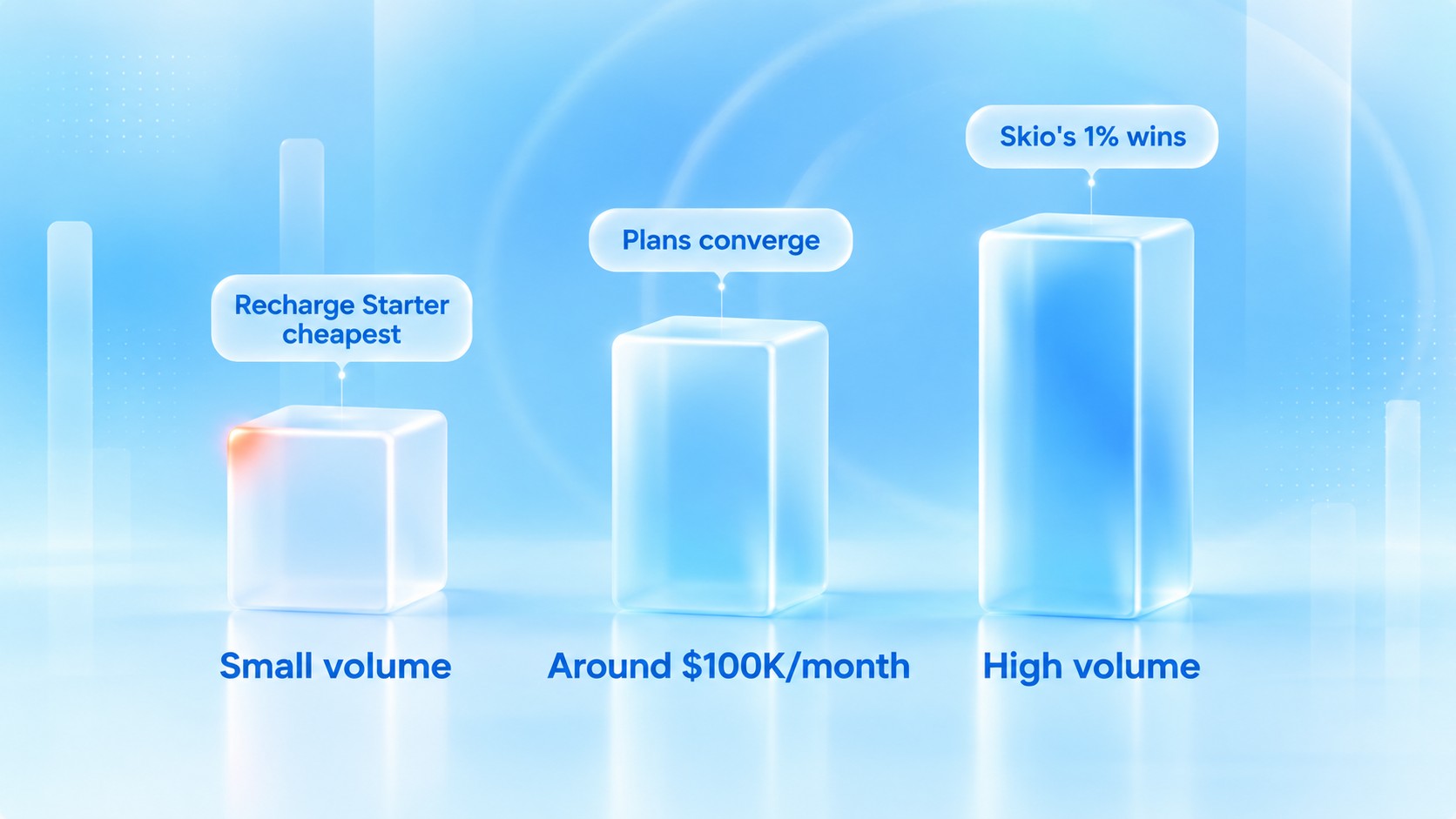
The pattern is clear. At small volume, Recharge Starter is cheapest because its base is lower. Around $100K a month the plans converge. At high volume, Skio's 1 percent beats Recharge's 1.34 to 1.49 percent, and the gap grows with revenue. Above that point, both companies offer custom pricing, so the real comparison is a negotiated quote.
Remember the fee that sits on top: both platforms charge in addition to your processor. Recharge says so explicitly on its pricing page, and Skio's 1 percent + 20¢ is likewise a platform fee, not payment processing. A brand paying its gateway its usual rate plus 1 to 1.5 percent to the subscription app is stacking fees on every rebill.
What the Recharge and Skio deal changes
Recharge announced the acquisition on April 30, 2026. The price was not in the official release, but Skio's founder said publicly that the company sold for $105M in cash, as TechCrunch reported. Together, the companies say they power more than 20,000 brands and process over $20B in GMV a year.
For merchants, both companies say nothing changes today: existing accounts, contracts and points of contact stay the same, and there is no forced migration. Skio says it will keep shipping on both platforms while the teams work out a combined roadmap over roughly the next 12 months.
What it means for your decision: in the short term, very little. In the longer term, it is a reminder that the subscription app you standardize on is a business asset owned by someone else, and its roadmap and pricing can change. That is not a reason to avoid either app. It is a reason to keep your subscriber data and payment tokens portable, so a platform decision never traps your recurring revenue.
The part neither app does: run your retention
Here is the point the app comparison rarely makes. Recharge and Skio are both software. They ship you the plumbing (subscription contracts, billing, a portal, dunning settings and cancel flows) and hand you the keys. With either one, you still:
Design and test the cancel-flow offers, win-backs and VIP saves.
Tune failed-payment recovery: retry timing, card updater use and recovery messaging.
Build and optimize the portal experience and the offers inside it.
Carry the migration risk for subscribers mid-dunning when you switch.
Read the churn cohorts and decide what to change.
Failed rebills are where most of that money leaks. A subscription app's retry logic can only retry on the processor you have. If that processor declines, throttles or freezes you, every rebill on it is at risk at once.
An app sells you the tool. Done-for-you subscription infrastructure sells you the operated system: retention flows, dunning, offers and the portal run for you, on payment rails built for rebills.
Why subscription brands switch to Apptics Checkout
Skio and Recharge are good apps, and after the acquisition they are one company's apps. Apptics Checkout is a different answer to the same goal. Instead of licensing subscription software and staffing the retention work around it, you get an operator team that turns your store into a subscription powerhouse and runs it: launch subscriptions, monetize checkout and increase AOV without Shopify Plus, on top of the Shopify store you already have, with Apptics Pay and Apptics Shield on the same stack.

Retention run for you, not handed to you: VIP portals, cancellation and save flows, offers and win-backs are built, tested and kept improving by the Apptics team, with a dedicated manager who sets up your checkout, upsells and subscription strategy. You stop being the person tuning cancel flows at midnight.
Rebills that do not die on one processor: Skio and Recharge retry declined rebills on the processor you have. Apptics routes transactions across multiple processors, with BIN-based routing and payments orchestration on every plan and AI smart retry and salvage on Enterprise, so a decline, a throttle or a frozen account does not take your rebill month down with it. One wellness brand lifted its first-attempt approval rate from 93.6% to 95.2% with orchestration.
You own your subscribers: Full control over your subscriptions. Your MRR stays portable across any gateway, and Apptics keeps subscription and payment tokens under your control so you can migrate, reroute and protect your business from shutdowns. That matters more than ever while the Skio and Recharge roadmap is being combined.
More revenue per subscriber: One-click post-purchase flows boost AOV up to 20%, and the checkout itself is fully customizable without Shopify Plus. One brand went from $0 MRR to a highest rebill month of $742,042.57. Another processed $8.96M in gross subscription volume across 52,350 subscribers.
Pricing that includes the checkout and payments: Apptics Starter is $750/month plus 1.9% + $0.29 per transaction (+$250/month per additional store), with full access to Apptics CRM, the checkout builder, split testing checkouts, full upsell and downsell customization, subscription vaulting, payments orchestration, BIN-based routing, dedicated onboarding and setup, and a Slack channel. Enterprise is $2,500/month with 5 stores included, 1.75% + $0.19 per transaction, 24/7 Slack support, a dedicated growth manager, a payment processing concierge, AI smart retry and salvage, and Apptics Shield exclusive rates. That is more than a subscription app's base fee, because it replaces the app, the checkout tooling, the payment routing and the people you would otherwise hire to run them.
"Apptics helped us scale subscriptions from 600k to 1M/month with fast, reliable support." Marco V., Subscription Box Founder
Skio vs Recharge vs Apptics Checkout at a glance:
Skio | Recharge | Apptics Checkout | |
|---|---|---|---|
Model | Self-serve app (a Recharge company) | Self-serve app | Done-for-you, run by an operator team |
Retention flows and offers | You build and test them | You build and test them | Built, tested and run for you |
Failed rebills | Retried on your one processor | Retried on your one processor | Routed across multiple processors, AI smart retry and salvage on Enterprise |
Chargeback protection | Not included | Not included | Apptics Shield, up to 97% chargeback reduction |
Published pricing | From $499/mo annual + 1% + 20¢ | From $99/mo + 1.49% + 19¢ | From $750/mo + 1.9% + $0.29, checkout and payments included |
Skio and Recharge pricing from their own pricing pages; Apptics pricing from apptics.ai/pricing.
When Apptics is the better fit: you are a Shopify DTC brand where subscriptions are a core revenue line, nobody on your team has the time to run retention and dunning properly, failed rebills or processor risk are costing you real money, or you want checkout, subscriptions, payments and chargebacks owned by one team. If you are pre-launch and just want a cheap subscribe button, start with an app; once retention is the bottleneck, that is where Apptics wins. See Apptics Checkout for how the subscription layer works, or compare the wider field in our guide to the best Shopify subscription apps.
How to choose between Skio and Recharge
Match the choice to where you are, not to the longest feature list.
If you are early or price-sensitive: Recharge Starter, or its $25/mo plan for your first 50 subscribers, keeps the base fee low while you learn what your subscribers respond to.
If you are scaling fast and want the premium portal: Skio is built for that brand, and its lower percentage pays off as subscription revenue climbs. Run the math at your 12-month target, not today.
If you want the safest long-term bet: Recharge is the parent company now. Choosing it puts you on the platform that owns the roadmap for both.
If retention labor is the bottleneck: switching apps will not fix it. Apptics Checkout is the stronger choice here, because the team runs your retention flows, offers and rebill recovery for you across multiple processors instead of handing you another dashboard.
Critical questions answered
Is Skio better than Recharge? Neither is better for everyone. Skio is strong for fast-growing brands that want a premium portal and white-glove migration. Recharge is the established default with a lower entry price and the deepest ecosystem. At high volume, Skio's 1 percent fee can make it cheaper.
Is Skio cheaper than Recharge? At low volume, no: Skio Scale starts at $499/mo billed annually, against $99/mo for Recharge Starter. At around $100K a month in subscription revenue the costs are similar, and above that Skio's lower percentage usually wins on list prices.
Did Recharge buy Skio? Yes. Recharge announced the acquisition on April 30, 2026. Skio's founder said it sold for $105M in cash. Both products continue to operate for now.
Should I migrate from Skio to Recharge after the acquisition? Not because of the deal alone. Both companies say there is no forced migration. Wait for the combined roadmap, and keep your subscriber data and payment tokens portable either way.
The bottom line
Skio vs Recharge is no longer a fight between rivals, but it is still a real product choice. Recharge is the established, lower-entry-price default with the deepest ecosystem. Skio is the premium, fast-moving option whose lower percentage pays off at scale. Both are now Recharge companies, both charge on top of your processor, and both leave the retention, dunning and offer work to you. Pick the app that fits your stage and model the stacked fees at your growth target. But if the real constraint is who runs retention and rebills, another app will not fix it. Apptics Checkout gives a Shopify DTC brand the subscription engine run for you, with rebills routed across multiple processors, subscribers and tokens you own, and Apptics Pay and Apptics Shield on the same stack. Book a demo with Apptics and the team will analyze your store and map out the best next steps for your subscription revenue.
Frequently asked questions
What is the difference between Skio and Recharge?
Recharge is the long-established Shopify subscription platform with tiered pricing from $99/mo. Skio is a newer, Shopify-focused platform known for its portal and hands-on migration, priced from $499/mo billed annually with a lower 1 percent transaction fee. Since April 2026, Skio is a Recharge company.
How much does Recharge cost?
Per its pricing page, Starter is $99/mo plus 1.49 percent plus 19¢ per transaction and Plus is $499/mo plus 1.34 percent plus 19¢, with Custom volume-based pricing. Its App Store listing also shows a $25/mo plan with no transaction fees for the first 50 subscribers.
How much does Skio cost?
Skio's Scale plan is $599/mo billed monthly or $499/mo billed annually, plus 1 percent plus 20¢ on orders involving a subscription. Enterprise pricing is custom.
Is Skio still operating after the Recharge acquisition?
Yes. Both companies say Skio continues to operate and onboard merchants, with existing contracts and contacts unchanged while a combined roadmap is developed.
Do subscription apps recover failed payments for me?
They ship retry and dunning settings, but tuning recovery is your job, and retries are limited to the processor you have. Apptics Checkout runs rebill recovery for you, routing transactions across multiple processors, with AI smart retry and salvage on the Enterprise plan.
Key takeaway: Recharge is the established, lower-entry-price Shopify subscription default; Skio is the premium, fast-moving option whose 1 percent fee wins at higher volume. Recharge has owned Skio since April 2026, both still operate, and both leave retention, dunning and offers to you. If you want that work done for you, with rebills routed across multiple processors and MRR that stays portable, Apptics Checkout is the better choice for a scaling Shopify brand. Book a demo to see it on your store.
Check out more of our stories.

The Best Shopify Subscription Apps (2026)
Compare the best Shopify subscription apps (Recharge, Loop, Bold, Skio, Stay Ai, Smartrr, Appstle, Ordergroove): what each is best for, real pricing models, and the retention work you still have to run yourself.
Payments

Shopify Checkout Customization: The Complete 2026 Guide
What you can customize in the Shopify checkout on each plan, the changes that lift conversion and AOV, and how to get deep customization without Shopify Plus.
Payments

Apptics Pay vs Maverick Payments: Which Fits a Scaling Ecom Brand?
Maverick Payments is a single full-service processor with a proprietary gateway. Apptics Pay is done-for-you multi-processor orchestration with MID redundancy. Compare the models, high-risk support, pricing, and fit.
Payments

Apptics Pay vs Shopify Payments: Which Fits Your Store?
Shopify Payments is the easy built-in default, but it is a single Stripe-backed processor that can be held or suspended. Compare it with Apptics Pay's done-for-you multi-processor orchestration for high-risk, international, and subscription brands.
Payments