


Apptics Checkout

Short answer: yes, TagadaPay is a legitimate payment processor and the native payment layer inside the Tagada Ecommerce OS. Here is what it is, why a TagadaPay* charge shows up on card statements, what it costs, and when a done-for-you option fits better.
Is TagadaPay legit?
If you are asking whether TagadaPay is legit, the honest answer is yes. TagadaPay is the payment processor built into Tagada, a platform that describes itself as an Ecommerce OS: checkout, funnels, CRM, subscriptions and payment orchestration in one place, run as your store or plugged into Shopify. Merchants apply, get underwritten, and process card, Apple Pay and Google Pay payments through it. It publishes its pricing, its contract terms and full developer documentation, and it ships real SDKs. That is not what a scam looks like.
People search the question for two very different reasons, and it helps to separate them. Some are merchants checking a newer platform before they move volume onto it. Many more are shoppers who saw "TAGADAPAY*" on a bank or card statement and do not recognize it. Both questions have clear answers, and we cover both below.
The more useful question for a merchant is not whether TagadaPay is real. It is whether a self-serve processor and Ecommerce OS is the right shape for your team, and what the terms (reserves, dispute fees, payout timing) mean once you are processing at scale. This review covers what TagadaPay does well, the trade-offs, and why many Shopify DTC brands end up choosing Apptics Checkout, a done-for-you checkout, payments and chargeback stack, instead of running another platform themselves.
The short version: TagadaPay is legit. It is the native processor inside Tagada's Ecommerce OS, with published pricing from 2.9 percent + $0.29, published reserve and dispute terms, and a portable card vault. A TagadaPay* charge on your statement is a purchase from a store that uses TagadaPay, so contact that store first. For a Shopify DTC brand, though, the better choice is usually Apptics Checkout: the same checkout, upsells and multi-processor payments, built and run for you, with Apptics Shield chargeback protection on the same stack.
What is TagadaPay?
TagadaPay is the payment-processing layer of Tagada. Tagada's own pitch is an orchestration layer for the full customer journey: convert, upsell, recover and renew, with checkout, CRM and a funnel builder sharing the same data. TagadaPay is the part that actually moves the money.
Managed processing: In TagadaPay's managed mode, Tagada is your payment provider. Per its documentation, onboarding, underwriting, acquiring, settlement, payouts and disputes all run through TagadaPay, and you never hold processor credentials yourself.
Bring your own processor: Merchants who already have a merchant account can connect it instead. Tagada's docs list connectors for processors such as Stripe, NMI, Authorize.Net, Checkout.com, Airwallex and Paysafe, and the platform can route between them.
Orchestration and routing: Tagada markets smart routing across processors, cascade on decline and retries, the same core mechanics a payment orchestration layer uses to lift approvals.
A vault you own: TagadaPay's headline is "Live in 24h. You own your vault." Cards, tokens and customer data sit in a PCI vault the merchant controls, and Tagada says they export in one click if you leave.
So TagadaPay is not just a gateway and not just a funnel builder. It sits in the same part of the stack as Apptics Pay and Apptics Checkout, which is why the two come up in the same searches.
Why is there a TagadaPay charge on my card?
If you are a shopper, this is probably the section you came for. A charge that reads something like "TAGADAPAY*" followed by a shortened store name (sometimes with "TAGADAPAY.COM" and a state code) means you bought something from an online store that processes its payments through TagadaPay. TagadaPay is the processor. The business after the asterisk is the seller.
The statement text is called a billing descriptor, and processors let each merchant set its own. That is why the second half of the descriptor changes from charge to charge: it is a different store each time. It is also why the text is often cut off or hard to recognize, because card statements only show a limited number of characters.
Check your email for an order confirmation on the same date and for the same amount. The store name after the asterisk is the best clue.
If you find the order and something is wrong (a subscription you did not expect, a missing delivery), contact that store first. It is usually the fastest way to a refund.
If you do not recognize the purchase at all, or the store does not respond, contact your bank or card issuer and ask them to review or dispute the charge.
A TagadaPay* charge is not a sign of a scam on its own. It works the same way as any other processor descriptor. The question is whether you made the purchase, and only the store and your bank can settle that.
What TagadaPay does well
Give the platform its due. For a merchant who wants one self-serve system and has the team to run it, TagadaPay gets several things right.
Published pricing with no setup fees and no monthly minimums. Its processor page says rates start from 2.9 percent + $0.29 per successful transaction, with high-risk verticals priced case by case.
Fast onboarding. Tagada markets automated onboarding and going live in under 24 hours, and a full sandbox with a real API and test cards before you apply.
Daily payouts and wide currency support. Its site lists daily payouts and 135+ currencies.
A portable vault. Owning your cards and tokens is a genuine protection against lock-in, and it matters if you ever need to move processors.
Routing across processors, so one processor declining or tightening does not have to stop your revenue.
A real developer platform: headless and Node SDKs, REST APIs and public docs.
This is a serious, modern product. Nothing here is a red flag. The questions worth asking are about fit and terms, not legitimacy.
The terms that matter once you are processing
The part most reviews skip is the contract. TagadaPay deserves credit for publishing it plainly on its processor page, and these are the lines a scaling brand should read before moving volume.

Rolling reserve: Usually 10 percent of each sale, held 60 to 90 days and then released. It can be lower or zero depending on history and category, and Tagada says its risk system can raise it up to 40 percent if chargebacks or alerts spike.
Payout timing: Daily payouts, with sales payable once they clear, 2 days after capture (T+2) in the US, Canada, the UK, the EU and Switzerland, and longer in some markets and on some high-risk contracts.
Disputes: $25 per dispute and $30 per chargeback alert, unless your agreement says otherwise.
Leaving: Either side can end the contract with 30 days' notice. Your remaining balance and reserve can be held for up to 180 days after the contract ends, longer while a chargeback or claim is open.
None of this is unusual for a processor that accepts higher-risk categories. But it shows where the real exposure sits: a chargeback spike raises your reserve and your dispute fees at the same time. That is why the chargeback side of the stack matters as much as the processor itself.
TagadaPay pricing, in plain numbers
Tagada publishes two kinds of fees, and it helps to keep them apart.
Processing on TagadaPay: from 2.9 percent + $0.29 per successful transaction, per its processor page.
The Tagada platform (checkout, funnels, orchestration, subscriptions, CRM and email): a CRM fee of 1.25 percent + $0.29 per successful transaction, plus a $75 per week platform fee that its homepage says is waived above $50K a month. Tagada says processing on TagadaPay reduces the CRM percentage.
Pricing pages change, and the exact figures depend on your category and volume, so confirm current terms with Tagada directly. For a side-by-side with Apptics pricing, see Apptics vs TagadaPay.
The real decision: who operates the stack
Because legitimacy is settled, the choice comes down to operating model. A processor and an Ecommerce OS do not optimize themselves. Someone has to build the funnels, tune routing, watch approval rates and keep chargebacks under control.
What you're weighing | TagadaPay (self-serve) | Apptics (done-for-you) |
|---|---|---|
Who builds checkout and upsells | You, in the builder | Operator team, split-tested for you |
Who tunes routing and MIDs | You configure it | Secured and run for you |
Processing | TagadaPay or your own processor | Multi-bank processing (35+ banks) |
Chargebacks | $25 per dispute, $30 per alert | Apptics Shield, up to 97% chargeback reduction |
Who you call at 2 a.m. | Support on Slack Connect | The same team that runs your stack |
Pricing shape | From 2.9% + $0.29, plus platform fees | Starter $750/mo + 1.9% + $0.29 per transaction |
TagadaPay details are from Tagada's public pages as of October 2026. Apptics details are from apptics.ai. Confirm current terms with each provider directly.
Neither column is wrong. Plenty of brands want a powerful platform and have an operator to run it. The point is that "is it legit?" does not answer "who runs it?", and that second question decides your results.
Where a self-serve platform falls short
The limitation is not the software. It is that you run it. A self-serve Ecommerce OS means someone on your team has to build and test funnels, configure routing rules, watch reserve and dispute levels, and react when a processor tightens. That is ongoing work that no rate card captures.
That gap matters most when: nobody on your team owns conversion and payments full time, your dispute ratio is already climbing, you sell in a category where reserves bite, or you would simply rather have the results delivered than operate one more platform.
Why scaling brands switch to Apptics Checkout
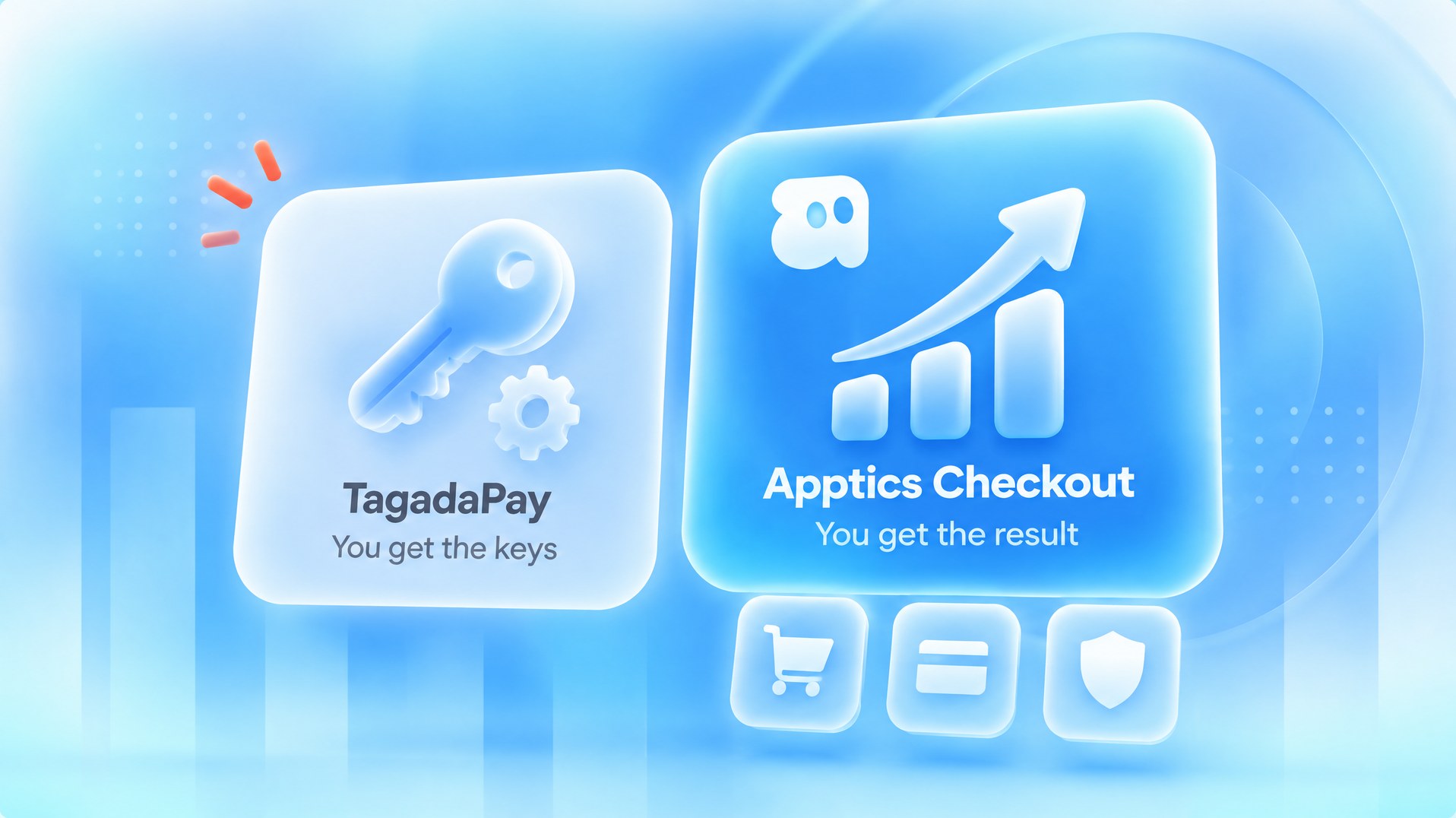
TagadaPay hands you a capable platform and the keys. Apptics Checkout hands you the result. An operator team rebuilds your checkout and funnel on top of the Shopify store you already have, builds and split-tests the upsells, and keeps improving it, with Apptics Pay and Apptics Shield running payments and chargebacks on the same stack. For a Shopify DTC brand, that is the better trade: the checkout, routing and subscription capability you would get from TagadaPay, without becoming the person who has to run it.
A checkout built to convert, run for you: Customize your checkout without Shopify Plus, with one-click post-purchase flows that boost AOV up to 20 percent. Apptics case studies show 50 percent more revenue per visitor, $1.44M in upsell revenue from post-purchase flows, average order value pushed past $100, and one brand going from $241K to $1.4M in monthly revenue in 90 days after a full funnel rebuild.
Payments that keep flowing: Apptics Pay adds payments orchestration and BIN-based routing across multi-bank processing (35+ banks), and most qualified merchants are approved within 48 to 72 hours. One international brand scaled its monthly volume cap from $250K to $2.5M in two months.
Chargebacks stopped before they cost you: On TagadaPay, every dispute costs $25, every alert $30, and the reserve can rise to 40 percent when chargebacks spike. Apptics Shield stops disputes before they are filed, with up to 97 percent chargeback reduction, RDR alerts from $13-19 and Ethoca alerts from $17-27, no monthly fee and no lock-in. You only pay for valid alerts.
Your customers, your tokens, your data: Apptics keeps subscription and payment tokens under your control, so you can migrate, reroute and protect your business from shutdowns. Your MRR stays portable across any gateway.
Pricing you can plan around: Starter is $750/month plus 1.9% + $0.29 per transaction (+$250/month per additional store), with full access to Apptics CRM, the checkout builder, split testing, full upsell and downsell customization, subscription vaulting, payments orchestration and dedicated onboarding and setup. Enterprise is $2,500/month with 5 stores included, 1.75% + $0.19 per transaction, a dedicated growth manager, a payment processing concierge, AI smart retry and salvage, and Apptics Shield exclusive rates.
"We started working with Apptics because we needed more than just another agency or software tool. We needed a team that actually understood eCommerce, subscriptions, payments, and the problems that come with scaling." Ethan, 8-Fig Ecommerce Operator
Apptics has helped 300+ brands scale from 6 to 8 figures and beyond. If you are weighing TagadaPay, book a call with Apptics to discuss your goals, have the team analyze your store, and map out the best next steps for growth. For the full head-to-head, see Apptics vs TagadaPay.
Who TagadaPay fits, and who it does not
TagadaPay fits you if: you want one self-serve Ecommerce OS, you value owning a portable vault, you are comfortable with the published reserve and dispute terms, and you have someone who will live in the dashboard to build funnels and tune routing.
It fits you less well if: your time is the bottleneck, nobody owns chargebacks, a reserve increase would hurt your cash flow, or you want checkout, payments and dispute prevention handled by one team instead of configured by you.
Apptics Checkout is the better fit if: you run a Shopify DTC brand, you want your checkout, upsells and subscriptions built and split-tested for you without replatforming, you need payments spread across multiple processors so one shutdown cannot stop revenue, and you want chargebacks prevented in the same stack rather than paid for per dispute.
Critical questions answered
Is TagadaPay a scam? No. It is a real payment processor inside the Tagada Ecommerce OS, with published pricing, published contract terms, public developer docs and SDKs. A charge you do not recognize is a purchase from a store that uses TagadaPay, not a charge from a scam company.
Why does TagadaPay* appear on my bank statement? Because the store you bought from processes payments through TagadaPay. The text after the asterisk is that store's name, often shortened. Check your order emails for the same date and amount, contact the store, and go to your bank if you do not recognize the purchase.
Is TagadaPay a good processor for high-risk brands? It accepts high-risk verticals, priced case by case, and publishes its terms: a usual 10 percent rolling reserve held 60 to 90 days that can rise to 40 percent if chargebacks spike. Whether that works depends on your dispute ratio and cash flow.
What is the difference between Tagada and TagadaPay? Tagada is the Ecommerce OS (checkout, funnels, CRM, subscriptions, orchestration). TagadaPay is its native payment processor. You can use Tagada with TagadaPay or with your own processor.
The bottom line
TagadaPay is legit. It is the native processor inside Tagada's Ecommerce OS, with published pricing from 2.9 percent + $0.29, a portable vault, routing across processors and clearly stated contract terms. If you found it on your card statement, it means you bought from a store that uses it, so start with that store. For merchants, the real question is not legitimacy but who runs the stack. TagadaPay is self-serve, and its reserves and dispute fees rise when chargebacks do. Apptics Checkout gives a Shopify DTC brand the outcome instead: a checkout rebuilt and split-tested for you, multi-processor payments through Apptics Pay, and chargebacks prevented by Apptics Shield, all run by one team. If that is the result you want, book a demo with Apptics.
Frequently asked questions
Is TagadaPay legit?
Yes. TagadaPay is the payment processor built into Tagada's Ecommerce OS. It publishes its pricing (from 2.9 percent + $0.29 per successful transaction), its reserve and dispute terms, and full developer documentation.
What is a TAGADAPAY* charge on my card?
It is a purchase from an online store that uses TagadaPay to process payments. The text after the asterisk is the store's name. Check your order emails, contact the store first, and contact your bank if you do not recognize the charge.
Who owns TagadaPay?
TagadaPay is part of Tagada, which runs the checkout, funnel, CRM and payments platform it sits inside.
How much does TagadaPay cost?
Tagada's processor page lists rates from 2.9 percent + $0.29 per successful transaction with no setup fees or monthly minimums. The wider Tagada platform adds a CRM fee and a weekly platform fee. Confirm current terms with Tagada.
What is the best TagadaPay alternative for a Shopify brand?
Apptics Checkout. An operator team rebuilds and runs your checkout, upsells and subscriptions on top of your existing Shopify store, with multi-processor payments through Apptics Pay and chargeback prevention through Apptics Shield. Plans start at $750/month plus 1.9% + $0.29 per transaction.
Key takeaway: TagadaPay is a legitimate processor and the payment layer of Tagada's Ecommerce OS, and a TagadaPay* statement charge is a purchase from a store that uses it. For merchants, the decision is operating model: TagadaPay is self-serve with published reserve and dispute terms, while Apptics Checkout builds and runs your checkout, upsells and subscriptions for you, with Apptics Pay and Apptics Shield on the same stack. Book a demo to see what Apptics would run for your store.
Check out more of our stories.

The Best Shopify Subscription Apps (2026)
Compare the best Shopify subscription apps (Recharge, Loop, Bold, Skio, Stay Ai, Smartrr, Appstle, Ordergroove): what each is best for, real pricing models, and the retention work you still have to run yourself.
Payments

Shopify Checkout Customization: The Complete 2026 Guide
What you can customize in the Shopify checkout on each plan, the changes that lift conversion and AOV, and how to get deep customization without Shopify Plus.
Payments

Apptics Pay vs Maverick Payments: Which Fits a Scaling Ecom Brand?
Maverick Payments is a single full-service processor with a proprietary gateway. Apptics Pay is done-for-you multi-processor orchestration with MID redundancy. Compare the models, high-risk support, pricing, and fit.
Payments

Apptics Pay vs Shopify Payments: Which Fits Your Store?
Shopify Payments is the easy built-in default, but it is a single Stripe-backed processor that can be held or suspended. Compare it with Apptics Pay's done-for-you multi-processor orchestration for high-risk, international, and subscription brands.
Payments