


Apptics Pay
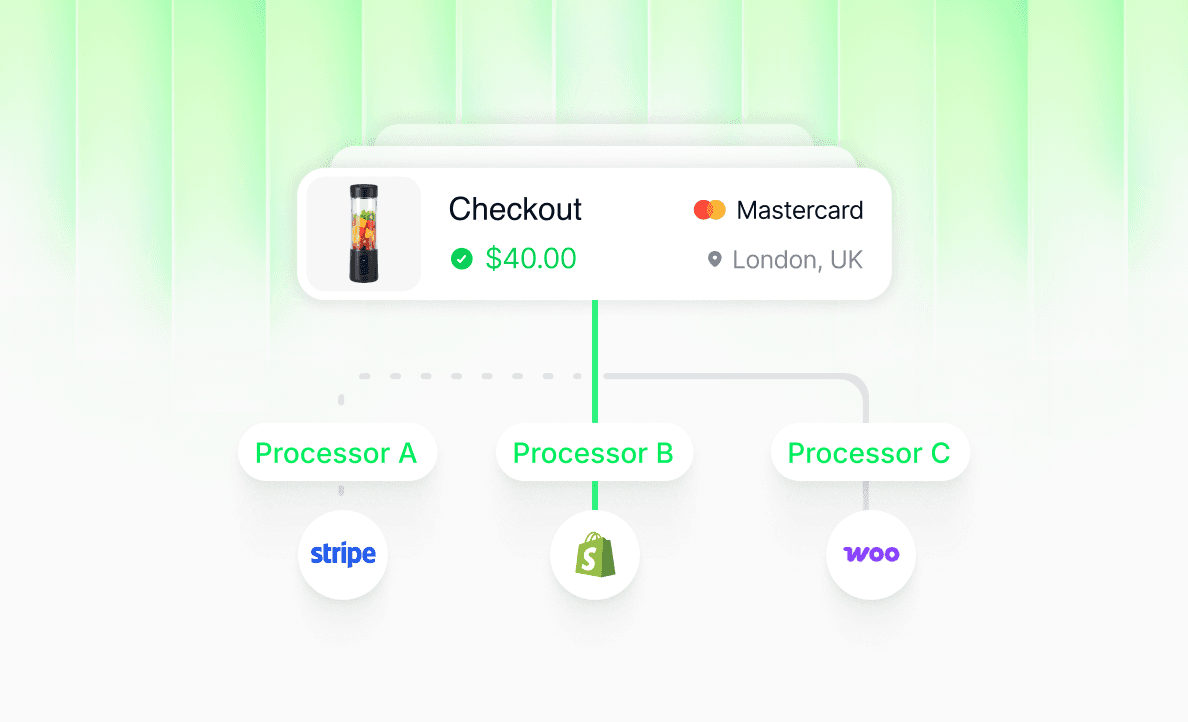
Stripe is the fastest way to start taking payments. But a single-processor account is a single point of failure once you scale into high-risk, international, or subscription volume. Here is how the two setups actually compare.
The comparison nobody makes until their account gets frozen
Most merchants do not compare Apptics Pay vs Stripe on day one, and they should not. Stripe is one of the best ways in the world to start accepting payments. You sign up, drop in a few lines of code, and you are live in an afternoon with no underwriting call and no dedicated merchant account to wait on. For a low-risk store finding product-market fit, that speed is exactly right.
The comparison starts to matter later, usually around the time a brand is doing real volume in a category a big aggregator watches closely: supplements and nutraceuticals, subscriptions and rebills, international selling, or anything with an elevated dispute rate. At that stage the thing that made Stripe great at the start, one shared account you can join instantly, becomes the thing that can stop your business overnight. One risk flag, one chargeback spike, one policy review, and payouts pause on the single account every dollar flows through.
This is not a Stripe takedown. Stripe does what it is built to do extremely well. The honest question is different: when payments become the constraint on your growth, is one processor enough, or do you need redundant infrastructure that keeps charging cards when any single processor says no? That is the real Apptics Pay vs Stripe decision, and it comes down to architecture, not brand.
The short version: Stripe is a single-processor aggregator: fast to start, excellent for low-risk and developer-led stores, but one account is one point of failure. Apptics Pay is done-for-you multi-processor orchestration: multiple merchant accounts (MIDs), cascade routing that salvages declined transactions, and high-risk plus international acceptance, run for you by an operator team. Start on Stripe. Move to orchestration when payments become the thing capping your growth.
Two completely different models under the hood
Before comparing features, it helps to see that these are not two versions of the same thing. They are two different architectures with different failure modes.
Stripe is an aggregator (a payment facilitator): New merchants are not fully underwritten for their own dedicated merchant account before boarding. They are added to Stripe's shared, pooled account and can start charging almost immediately. High-risk industry sources describe this model, while Stripe markets its own onboarding as instant. The tradeoff of that speed is that risk is largely managed after you board, through automated models that protect Stripe's aggregate pool, which is the mechanism those sources cite for sudden freezes when a merchant scales or trips a risk signal.
Apptics Pay is multi-processor orchestration: Instead of one shared account, Apptics builds redundant infrastructure across multiple merchant accounts (MIDs) so volume is distributed and no single processor is a choke point. If one processor declines a transaction or throttles you, routing sends the transaction elsewhere. It is not a processor or a bank itself. It secures, runs, and optimizes the processing layer for you, as part of one stack alongside Checkout and Shield.
That single architectural difference, one shared account versus many redundant ones, is what drives almost every other difference below. It is why Stripe can freeze a growing account, and why an orchestrated setup is built so that one freeze does not stop the business.
Why single-processor accounts freeze at exactly the wrong time
The pattern high-risk processors describe is consistent: because underwriting is light at signup, Stripe watches for risk after you are already live. Growth itself can look like risk. A sudden volume jump, a run of small transactions, a dispute cluster, or a product category that trips a rule can all trigger a review. Factors Stripe and analysts cite for holds and pauses include chargebacks and disputes, refund issues, restricted products, unusual transaction volume or value, card testing, fulfillment problems, and missing documentation.
The reason this hurts most at scale is simple math: on a single-processor account, 100 percent of your revenue runs through one relationship. When that relationship pauses, everything pauses. There is no second rail to fall back on.
Holds, reserves, and what Stripe actually publishes
Stripe's own documentation is worth reading plainly, because a lot of scary numbers online are not actually Stripe's stated policy. Stripe defines a reserve as a temporary hold on a portion of a business's funds for a predetermined period, placed when funds might not be sufficient to cover disputes, or due to industry delivery windows, elevated dispute activity, or unexplained volume spikes. Stripe uses fixed and rolling reserves, states you cannot reserve funds for longer than 180 days, and notes that in rare cases a reserve may be required indefinitely.
What Stripe does not publish is a specific reserve percentage. Figures like a fixed percent held for a fixed number of days are third-party estimates, not Stripe's stated policy, so treat them as reported rather than fact. The same goes for the commonly cited 90 to 180 day hold after account closure: that framing comes from industry guides explaining that card-network dispute windows can run months, not from a quoted Stripe line, though Stripe's own 180 day maximum reserve statement corroborates the upper bound.
The point that matters for operators: The exact reserve percentage is beside the point. The structural issue is that any reserve or hold lands on the one account carrying all your volume. Redundant infrastructure exists so a hold on one processor does not freeze the cash flow of the entire business.
What Stripe actually restricts (fairly stated)
It is worth being precise here, because the internet overstates Stripe's ban list. Stripe does prohibit a real set of categories, including gambling, marijuana and cannabis, and, under the heading of nutraceuticals and pseudo-pharmaceuticals, unsafe products making harmful claims. It restricts others case-by-case with documentation, including CBD, legal firearms, and pharmaceuticals, medical devices, and telemedicine.
One correction on a myth: Stripe does not blanket-ban all dietary supplements. Its own list phrases the restricted category as nutraceuticals and pseudo-pharmaceuticals making unsafe or harmful claims, not ordinary supplements. If you are a compliant supplement brand, the risk is less an outright ban and more the freeze-at-scale dynamic above, since supplements, subscriptions, and higher dispute rates are exactly the profile automated risk models watch. The practical answer to that is not to argue category definitions with an aggregator. It is to run on infrastructure built to accept and sustain that profile.
What multi-processor orchestration actually does
Orchestration is not a buzzword for the same thing with extra steps. It changes what happens to every transaction and what happens when volume grows. Here is the mechanism, in the order it matters:
Multiple MIDs (redundancy): Apptics builds and runs several merchant accounts rather than one, distributing volume across them. If one processor pauses, throttles, or declines, the others keep charging. That is the difference between a single point of failure and infrastructure that degrades gracefully instead of stopping.
Cascade and decline-salvage routing: When a transaction is declined on one processor, cascade routing reroutes it to a backup instead of writing it off. On a subscription business, those recovered rebills are pure retained revenue that a single-processor setup simply loses. A decline on one account is not the end of the attempt.
Approval-rate optimization: Routing logic, MID health, and processor selection are tuned to lift how many legitimate transactions actually get approved. For one wellness brand, orchestration moved first-attempt approvals from 93.6 percent to 95.2 percent. At scale, a point or two of approval rate is a meaningful revenue line, not a rounding error.
Volume caps that scale with you: Processors cap how much you can run. Apptics raises the ceiling as you grow rather than throttling you into a hold. One international wellness brand that could not secure processing before went from a $250K cap to $2.5M in 2 months.
Done-for-you, not a dashboard: The critical difference from a self-serve gateway is that an operator team secures the MIDs, sets the routing, and manages ongoing optimization for you. You are not learning payment infrastructure. You are handing it to a team that runs it.
Apptics Pay vs Stripe: the full comparison
Here is the side-by-side across the dimensions that decide whether a payment setup survives scale. The last column is why each line matters once you are past the early stage.
Dimension | Apptics Pay | Stripe | Why it matters at scale |
|---|---|---|---|
Architecture | Multi-processor orchestration across multiple MIDs | Single aggregated / shared account | One account is one point of failure |
If a processor pauses you | Volume reroutes to other MIDs | All payouts on that account pause | Redundancy keeps revenue flowing |
Declined transactions | Cascade routing salvages the retry | Decline is lost unless you retry manually | Recovered rebills are retained revenue |
High-risk / nutra / subscription | Built to accept and sustain it | Restricted or watched by risk models | Category profile drives freezes |
International merchants | Secures processing US processors decline | Availability varies, can be declined | Cross-border is where caps and holds hit |
Volume caps | Raised as you grow | Capped; spikes can trigger review | Growth should not look like risk |
Who runs it | Done-for-you operator team | Self-serve, you manage it | Owned optimization vs set-and-forget |
Time to first payment | Onboarding + underwriting to build MIDs | Live in an afternoon | Stripe wins early, clearly |
Developer / API depth | Managed for you, less to build | Best-in-class docs and API | Stripe wins for custom builds |
Part of one stack | Checkout + Pay + Shield, one team | Payments only (add-ons separate) | One revenue path, one owner |
Stripe capabilities and restrictions reflect Stripe's published legal and support pages as of 2026; confirm current terms directly with Stripe. Apptics figures are from Apptics case data, framed by vertical rather than named clients.
Read the table honestly and Stripe genuinely wins the bottom three lines: speed to start, developer experience, and simplicity for a low-risk store. Apptics Pay wins everything tied to surviving scale in a watched category. Which set of rows matters more is exactly the decision.
What orchestration looks like in the numbers
The argument is only worth anything if it shows up in revenue. A few examples from Apptics case data, framed by vertical rather than named brands:
An international merchant where payments was the blocker went from $241K to $1.4M monthly in 90 days as processing capacity opened up (September $241K, October $300K, November $619K, December $1.4M peak).
One wellness brand moved first-attempt approvals from 93.6 percent to 95.2 percent with orchestration, and had its volume cap scaled from $250K to $2.5M in 2 months.
One supplements brand ran 52,350 subscribers, $8.96M gross processed, and $3.45M in rebill revenue on orchestrated subscription infrastructure, at roughly an 82 percent approval rate.
A business with $240K a month in one-time sales and $0 recurring revenue became a seven-figure subscription business in 90 days once the payment layer could sustain rebills.
None of those are Stripe failures. They are cases where a single-processor setup was the constraint, and adding redundancy, routing, and higher caps removed it. General approval rates on Apptics-orchestrated infrastructure run around 94 percent.
A note on pricing and what you are really buying
Stripe's standard pricing is transparent and easy to reason about: on the pay-as-you-go plan, a common published figure is 2.9 percent plus $0.30 per successful domestic card charge, with no monthly or setup fee, plus surcharges for international cards and currency conversion. Dispute fees are commonly cited around $15 per dispute, though you should confirm the exact figure on Stripe's current US pricing page. Importantly, Stripe does not publish a dedicated high-risk rate card, because it does not operate as a dedicated high-risk processor, so treat any specific high-risk surcharge you see quoted elsewhere as unverified.
The real comparison is not headline rate against headline rate. It is a low sticker rate on an account that can freeze, versus infrastructure and an operator team that keep you processing and approved. A processing rate that looks cheap means nothing during a 180 day hold. The question to price out is total revenue captured and retained, not just cost per transaction.
Critical questions answered
Is Apptics Pay a Stripe replacement or an add-on? It is a different model, not a plugin on top of Stripe. Apptics builds and runs redundant multi-processor infrastructure for you. Many brands start on Stripe and migrate to orchestration when a single account stops being enough, keeping the storefront and moving the payment layer underneath.
Does Stripe actually ban all supplements? No. Stripe's own list restricts nutraceuticals and pseudo-pharmaceuticals that make unsafe or harmful claims, not ordinary dietary supplements. The bigger risk for a compliant supplement brand at scale is the freeze-at-scale dynamic, since supplements, subscriptions, and higher dispute rates are the profile automated risk models watch most.
Will I lose Stripe's speed and simplicity? You trade instant self-serve signup for underwriting and setup that build real MIDs, which takes longer up front. In exchange an operator team runs the infrastructure, so day-to-day you manage less, not more. If speed to first payment is your only concern, Stripe wins, and that is a fair reason to start there.
What happens to a declined rebill on each setup? On a single-processor account, a declined rebill is lost unless you manually retry it. With cascade routing, the transaction reroutes to a backup processor automatically, which is why orchestrated subscription businesses recover revenue that single-processor ones write off.
Who each one is right for
Stripe is the right call when: You are early, low-risk, and self-serve; you have developers who want best-in-class APIs and full control of a custom build; your category is not in a watched or restricted bucket; and speed to launch matters more than redundancy. For a large share of stores, especially at the start, Stripe is genuinely the correct choice, and there is no reason to overbuild before you need to.
Apptics Pay is the right call when: You are scaling real volume, ideally in the roughly $50K to $10M a month range; you are in high-risk, nutra, supplements, subscriptions, or international; you have felt a freeze, a hold, or a volume cap, or you cannot afford to; and you would rather hand payment infrastructure to an operator team than run it yourself. The trigger is almost always the same: payments has become the thing capping growth.
These are not mutually exclusive philosophies so much as different stages. Plenty of brands are right to start on Stripe and equally right to move to orchestration later. The mistake is staying on a single-processor setup out of inertia after the risk profile has clearly outgrown it.
The bottom line
Stripe is an excellent starting point and a genuinely great product for low-risk, developer-led, self-serve stores, and this comparison is not an argument that it is bad. It is an argument about architecture. A single aggregated account is fast and simple, and it is also a single point of failure that can freeze, hold, or cap you at the exact moment you are growing into high-risk, subscription, or international volume. Apptics Pay is the done-for-you answer to that: multiple MIDs for redundancy, cascade routing that salvages declines, approval optimization, volume caps that scale with you, and an operator team that runs it as part of one stack with Checkout and Shield. Start where the speed helps. Move to orchestration when payments becomes the constraint, not after it has already stopped your business.
Frequently asked questions
Is Apptics Pay a Stripe alternative?
It is an alternative model rather than a like-for-like swap. Stripe is a single-processor aggregator; Apptics Pay is done-for-you multi-processor orchestration across multiple MIDs, with cascade routing and high-risk plus international acceptance. Many brands start on Stripe and migrate to Apptics Pay when a single account stops being enough at scale.
Why do Stripe accounts get frozen?
Because Stripe underwrites lightly at signup and manages risk afterward on a shared pooled account, growth can trip automated risk models. Factors Stripe and analysts cite include chargebacks and disputes, restricted products, unusual volume or value, card testing, and missing documentation. On a single-processor setup, one pause stops all payouts, since everything runs through one account.
Does Stripe ban supplements?
Not outright. Stripe's own list restricts nutraceuticals and pseudo-pharmaceuticals that make unsafe or harmful claims, not ordinary dietary supplements. For compliant supplement brands the practical risk at scale is freezes and holds tied to category and dispute profile, which redundant multi-processor infrastructure is built to withstand.
What is cascade routing in payment orchestration?
Cascade routing reroutes a declined transaction to a backup processor instead of losing it. On subscription businesses this salvages rebills that a single-processor account would write off. It is one of the core reasons orchestrated setups retain revenue that single-processor setups lose.
When should I move off Stripe to a multi-processor setup?
When payments becomes the thing capping your growth: you are scaling real volume in high-risk, nutra, subscription, or international, or you have hit freezes, holds, or volume caps. Below that, Stripe's speed and simplicity are usually the right call. The signal to move is redundancy and acceptance mattering more than instant self-serve signup.
Key takeaway: Stripe is a single-processor aggregator: fast, simple, and excellent for low-risk and developer-led stores, but one shared account is one point of failure that can freeze, hold, or cap you as you scale. Apptics Pay is done-for-you multi-processor orchestration: multiple MIDs for redundancy, cascade routing that salvages declined rebills, approval optimization, volume caps that scale with you, and an operator team running it as one stack with Checkout and Shield. Start on Stripe; move to orchestration when payments becomes the constraint on growth.
Check out more of our stories.

The Best Shopify Subscription Apps (2026)
Compare the best Shopify subscription apps (Recharge, Loop, Bold, Skio, Stay Ai, Smartrr, Appstle, Ordergroove): what each is best for, real pricing models, and the retention work you still have to run yourself.
Payments

Shopify Checkout Customization: The Complete 2026 Guide
What you can customize in the Shopify checkout on each plan, the changes that lift conversion and AOV, and how to get deep customization without Shopify Plus.
Payments

Apptics Pay vs Maverick Payments: Which Fits a Scaling Ecom Brand?
Maverick Payments is a single full-service processor with a proprietary gateway. Apptics Pay is done-for-you multi-processor orchestration with MID redundancy. Compare the models, high-risk support, pricing, and fit.
Payments

Apptics Pay vs Shopify Payments: Which Fits Your Store?
Shopify Payments is the easy built-in default, but it is a single Stripe-backed processor that can be held or suspended. Compare it with Apptics Pay's done-for-you multi-processor orchestration for high-risk, international, and subscription brands.
Payments